



Tips for Project Sites
The management of plant and tools on construction sites is one of the areas where a business can find its various projects experiencing cost overruns unaware.
To effectively manage the mobilisation and deployment of construction equipment and tools on site, treat each site like a customer.

It doesn’t matter what percentage of your site requirements you cover by sending your own plant and what percentage you hire from an external supplier. Either way, you should treat your project sites as if it were a customer to the business. Since your internal “customer” can be associated with specific projects, one can manage the process of allocation and movement as an internal plant-hire business.
You don’t have to create Accounts Receivable invoices (unless you want to), but you can accurately track costs, mobilisation, assets, usage, and charging at the particular site, customer, and project level. We’ll discuss six focus areas that can help to manage, deploy, and allocate your assets more effectively when applying a “Project Site as a Customer” strategy.
1. Control: Charging and Orders.
When you start to view your project sites as customers, you will quickly realise that each project has its own unique challenges and needs. This should also be taken into consideration when you’re managing charges and plant hire orders as well, as there is no one-size-fits-all method that works for all sites.so flexibility is key.
For example, each site or project can have its own pricing information. There may be an internal standard rate for excavators, but rates may be higher due to remote locations or the density of projects in a particular area. Also, rates need to be controlled based on different variables such as hours, days, weeks, months, overtime, and duration. Again, flexibility ultimately gives you full control.

Contact Us Today!
Let's Partner on your Next Project.
2. Visible Traceability: Allocation & Delivery
Whether you use requisitions to trigger demand or there’s a central plant hire desk to handle requests for sending off and allocating plant, there should be a distinct process in place to manage them. Requisition items aren’t just for plant hire, they can become orders for tools, additional services or consumables as well. Once the requisition is received, the order can be fulfilled with the specific asset being requested.
If not already in place, have a mandate for your drivers that allows for sign off at the time of loading which can make a huge impact on understanding where plant is and for how long. Once your equipment is delivered on a project site, it must be signed for and the charge period will then begin. Having the site sign-off on the equipment’s condition at the time of delivery is also important to note, as you’ll see in the Equipment: Damage section of this post.
3.Tracing: Pickup & Return
The two sections above make pickups and returns much easier to manage. The request and fulfilment process you implement tells users (and your site) what assets/plant are where and when, so your site can quickly identify plant that is no longer in use, request an off-hire to end any further charges. This improves utilisation as plant no longer sits unused on a site simply because someone forgot it was there (or assumed someone is coming to get it).
4. Plant: Damage
It’s inevitable—your plant and tools will at some point return damaged. Your off-hire and return process should include an inspection to assess the physical repair of the assets before loading onto the truck. If it is a requirement for project sites to sign-off on the plant condition at the time of delivery, there should be no disputes as to who had ownership when the damage took place. Consider taking photos upon delivery and collection.
Charges for parts and labour should be billed back to the job site. Whether you include charges for loss of revenue during the plant’s down time will depend on a company’s policies and procedures.

5. Plant: Maintenance
Through the life span of your plant, regular maintenance and inspection is a requirement. Developing and implementing scheduled maintenance is imperative for the longevity of your assets. Depending on the type of equipment, you may want to have maintenance scheduled for intervals of time, such as every six calendar months, every 100 days on hire or at every 200 hours on the meter. Whatever method you choose, increase the efficiency of your mechanic by having them record the maintenance steps performed which will prove valuable over time, this could also be done on a mobile app.

6. Plant Management: Utilisation
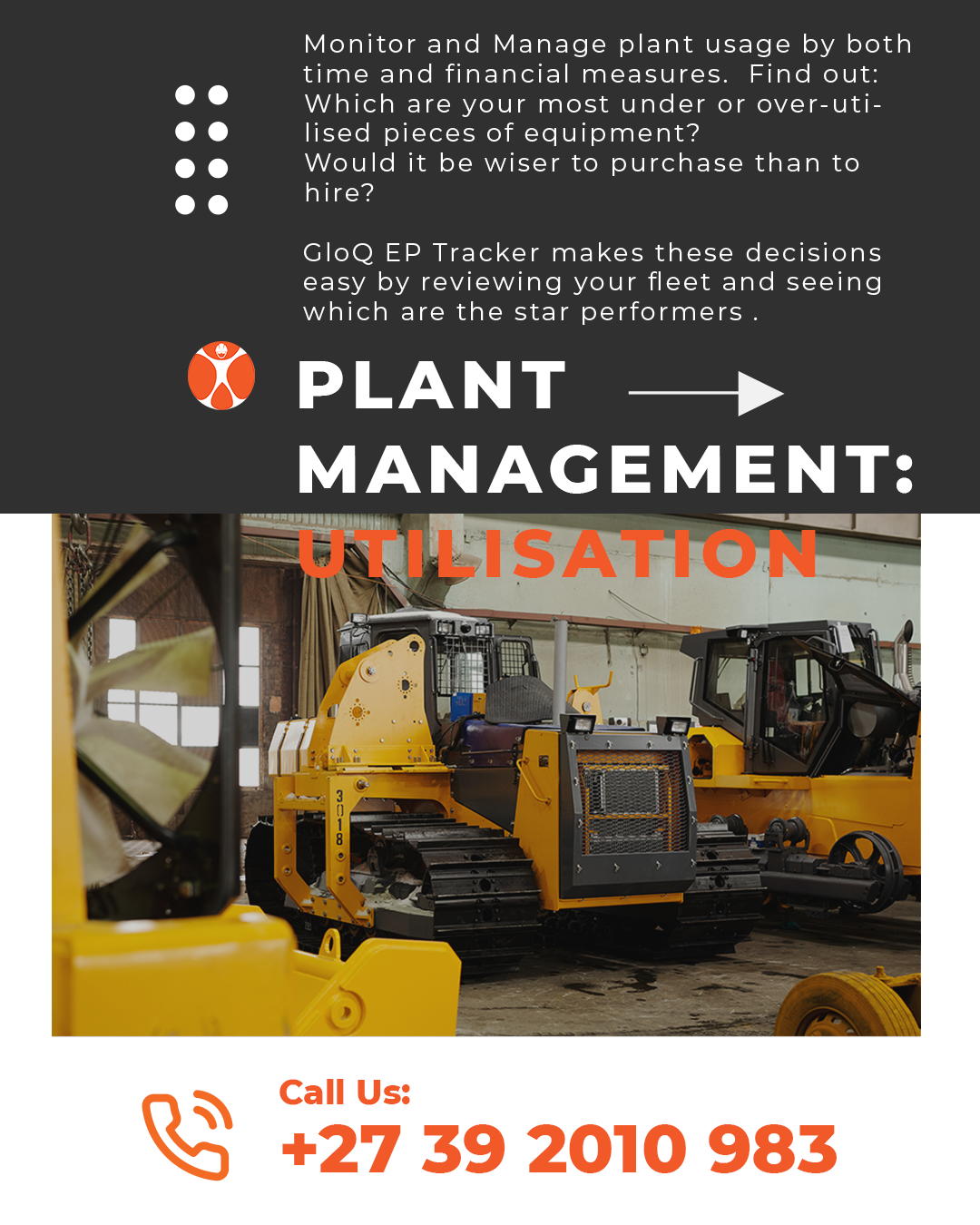
All delivery and off-hire are now being tracked, you can now monitor and manage plant usage by both time and financial measures. Which are your most under or over-utilised pieces of equipment? Would it wiser to purchase than to hire? These decisions can be made by reviewing your fleet and seeing which are the star performers.
How can GloQ help you?
Our Equipment and Plant Tracker (E&P Tracker) effectively tracks equipment, tools and material costs against all your projects and task codes from a simple solution.
Measure and Manage
GloQ can implement the E&P Tracker which can quickly view which projects or tasks are over-consuming your budget to enable you to take immediate action. Once implemented, the E&P Tracker will allow you to filter your data however you’d like and schedule reports to be delivered only when certain exceptions occur so you can prevent further overruns.


